Why Tennis Shoes Have Different Outsoles
Why tennis shoes have different outsoles comes down to surface-specific grip: learn how tread patterns developed and what their designs do on court.
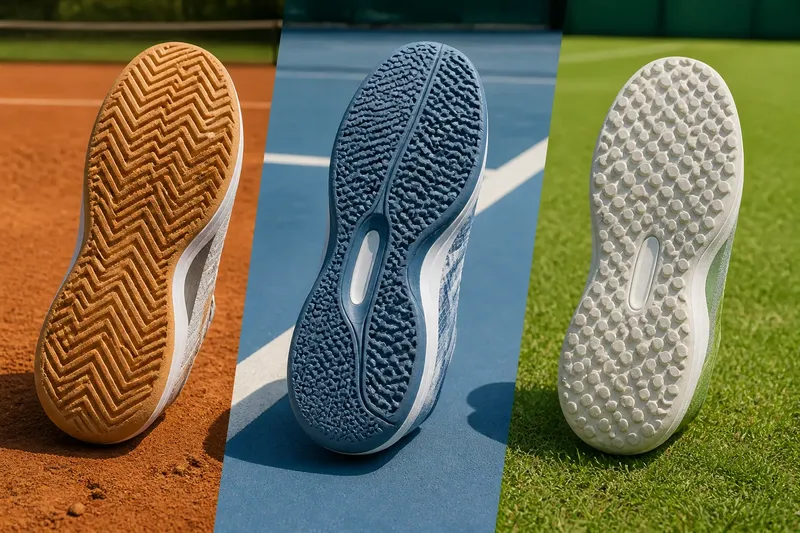
A tennis shoe’s outsole is shaped by the surface it must grip, release, and tolerate. Why tennis shoes have different outsoles becomes clear when you compare the tread under a clay-court shoe with the flatter pattern often used on hard courts: each design manages contact with the ground in a different way.
The outsole is the rubber layer beneath the shoe. Its grooves and raised areas form a tread pattern, while the rubber compound affects how that tread behaves. Court surfaces created distinct demands, so outsole design developed as a response to movement and wear—not as decoration or a simple ranking of shoes.
How did court surfaces shape outsole design?
Tennis asks players to accelerate, stop, pivot, and recover in short bursts. The surface influences how easily a foot can move during each action. On a court with loose material, tread needs to interact with that material; on a firm, consistent surface, broad contact and durable rubber become more important.
Early court footwear did not have to solve every surface problem with one sole. As tennis spread across clay, grass, and hard courts, makers developed patterns suited to the different ways those surfaces behave. The resulting designs are best understood as adaptations: grooves manage debris and sliding, while flatter or more closely patterned areas provide a broad contact patch.
Think of the tread like the grooves on a rain boot: channels give loose material somewhere to move, while the rubber between them makes contact with the ground. Tennis shoes refine that idea for quick lateral movement, repeated pivots, and the particular wear a court creates.
What does a clay-court outsole do?
Clay-court outsoles commonly use a herringbone pattern, with angled grooves running across the sole. The channels help shed clay rather than letting it pack into a smooth layer beneath the foot. When the tread stays open, a player can make a controlled slide and then push back toward the next shot.
Sliding is part of ordinary movement on many clay courts, but it is not the same as losing control. A suitable tread helps the foot move through the slide predictably and regain traction as the player changes direction. A sole clogged with clay may feel less responsive because the grooves no longer have room to do their job.
Clay-specific soles can also have tread extending across much of the outsole, including areas that contact the court during a slide. That coverage helps the shoe meet the surface through a range of foot positions. It does not mean every clay court or player will feel identical; court preparation and loose material can change the sensation underfoot.
Why are hard-court soles usually flatter?
Hard courts provide a firm base and abrade rubber through repeated stops and pivots. Their outsoles therefore tend to use a denser pattern with broad contact areas, often reinforced in high-wear zones such as the toe and the inner edge. The design aims to balance traction with a sole that can withstand frequent contact against an abrasive surface.
Compared with deep clay-style grooves, shallow or closely spaced tread is less likely to catch on a firm court during a quick turn. The rubber itself matters too: compound and thickness affect durability and feel, so the pattern alone does not describe the whole outsole.
Hard-court tread may still include grooves and directional shapes. “Flatter” does not mean completely smooth. It describes a pattern that generally emphasizes contact and wear resistance over channels built to clear loose court material.
How does grass change the outsole?
Grass courts can be slippery, particularly when the surface is damp or worn. Their shoes often use small, rounded nubs rather than long, continuous ridges. The nubs provide points of contact without behaving like spikes, while the sole remains suited to tennis movement and court rules.
Grass tread also reflects the need to avoid excessive damage to the playing surface. A design that grips through aggressive edges could tear or mark turf, so the outsole’s shape and height are constrained by the surface as well as by the player’s movement. Grass shoes are therefore not simply hard-court shoes with more prominent grooves.
Grass conditions can vary across a court: areas around the baseline and service boxes may be more worn than the rest. The pattern is designed for the playing surface as a whole, but the available traction can still change with moisture, wear, and maintenance.
What should you look for in an outsole pattern?
Read the tread as a map of how the shoe is meant to meet the court. These cues can help identify the design’s emphasis:
- Long, connected zigzags: often indicate a clay-oriented pattern that channels loose material.
- Broad rubber zones with shallow grooves: often point toward hard-court use and repeated abrasion.
- Small, separated nubs: commonly indicate a grass-court outsole intended for turf contact.
- Extra rubber at the toe or inner forefoot: addresses areas that often meet the court during lunges and pivots.
- Wear that has smoothed the grooves: means the original pattern may no longer interact with the surface as intended.
These are clues, not a universal code. Outsoles vary between models, and a tread can combine features. If the shoe label or manufacturer describes the intended surface, use that information to confirm what the pattern suggests.
How should outsole design guide a week of court use?
A simple routine helps keep surface-specific tread in view without turning every session into a gear inspection. At the start of the week, note which courts are on your schedule and match each session to footwear designed for that surface. If you play on more than one type, keep the pairs separate so clay does not fill the tread you plan to use elsewhere.
After a clay session, remove packed material from the grooves with a soft brush once the shoes are off court. Before a grass session, check that the small nubs remain distinct rather than flattened or torn. After hard-court play, look over the toe and forefoot for uneven smoothing, where repeated stops can wear away tread sooner.
Say you have a clay session followed by a hard-court match later in the week. You use the clay-pattern pair on clay, brush the grooves afterward, then reserve the hard-court pair for the later match. The observable result to look for is clean clay channels and a hard-court tread that remains free of loose clay, not a promised change in speed or grip.
Which outsole questions come up most often?
Can you use clay-court shoes on a hard court?
The deep channels are designed to manage loose clay and may wear differently on an abrasive hard court. Occasional use may be possible, but frequent play on hard courts is better matched to a sole intended for that surface.
Can one outsole work on every court?
Some shoes are marketed for multiple surfaces, but a pattern suited to one court may not manage another as effectively. Look at the manufacturer’s stated use and the actual tread rather than assuming that any tennis outsole is universal.
Why do tennis outsoles have different rubber patterns?
Patterns control how the sole contacts the ground, handles loose material, and wears through repeated movement. Clay, grass, and hard courts create different conditions, so their outsole designs emphasize different combinations of channels, contact area, and rubber coverage.
When is an outsole too worn to serve its purpose?
Look for smoothed-away grooves, missing nubs, or unevenly worn areas that change the shape of the tread. If wear has made the pattern hard to distinguish or the shoe feels unreliable during ordinary court movement, consider replacing it before relying on it for play.
Why tennis shoes have different outsoles is ultimately a question of how rubber meets a particular court. Check the tread after each week of play, especially where it touches down during stops and pivots; visible wear can tell you when a surface-specific pattern is losing the features it was designed to provide.