Clay, Grass and Hard Court: Watch the Bounce, Not the Colour
Learn to read clay, grass and hard-court bounce by tracking height, pace and rally rhythm, so each point makes more sense from the stands.
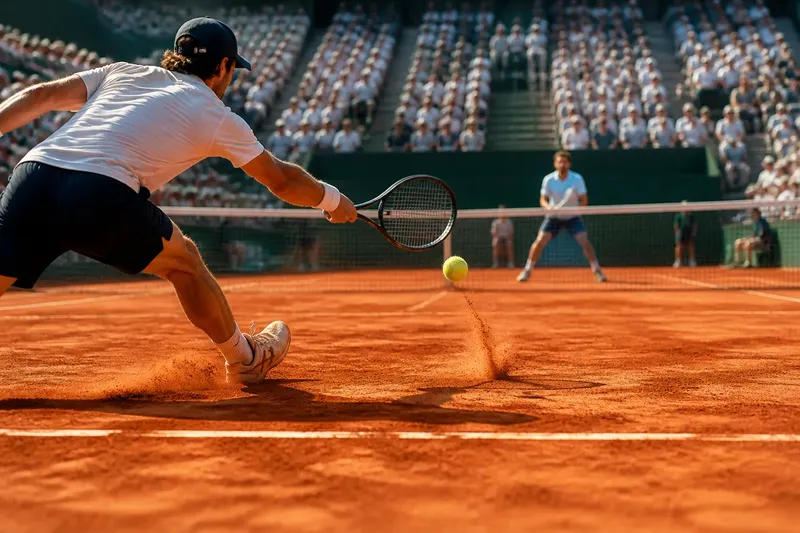
To understand a tennis point, watch the ball after it lands, not the court’s color. Clay, grass and hard court each shape bounce and rally rhythm, but the result also depends on the shot, the ball and the condition of the playing area. A spectator who follows the ball from impact to the next player’s contact can see those influences without turning court types into a ranking.
Start with three observations: how high the ball rises, how quickly it reaches the player, and how much time the player has to set up. Those clues explain why a rally can feel measured, abrupt or changeable. They are more useful than assuming every point on a given surface will behave alike.
What should you watch after the bounce?
Choose one rally and follow the ball from its landing to the opponent’s reply. A high, slower-looking bounce may give the receiver time to move behind the ball, while a lower or quicker arrival can make a compact, early contact more practical. The player’s preparation is part of the evidence: watch whether they wait, step forward, or reach while still moving.
Then notice what happens next. If both players can get into position, the rally may settle into repeated exchanges. If one player must meet the ball early or from an awkward position, the point may change direction quickly. That does not mean the court alone caused the outcome; placement, spin and movement matter too.
Think of the surface as a floor under a bouncing ball, much like a tabletop changes what a tossed toy does when it lands. The analogy is limited: tennis courts are built for play, and the incoming ball’s speed, spin and angle also shape its rebound.
How does clay change the rhythm?
Clay often invites spectators to look for a higher bounce and time to organize, especially when a player sends the ball with topspin. The receiver may have room to move behind it and prepare a full swing. Longer exchanges can follow, but they are not automatic: a short ball, a sharp angle or a well-timed approach can still bring the point forward.
Look for a player adjusting their position after each bounce. If they retreat to meet the ball at a comfortable height, or slide into place and recover, those movements help explain the rhythm. A player who takes the ball early may interrupt that pattern and deny the opponent time to settle.
Clay’s loose surface can also make footwork visible. A controlled slide may help a player reach a wide ball, but it can leave them needing extra time to recover. For a spectator, the useful question is not whether a rally is long; it is whether the bounce gives either player a chance to establish a preferred contact point.
Why can grass make timing feel different?
Grass is commonly associated with a lower, quicker-looking bounce, so a player may need to meet the ball sooner and keep their preparation compact. Watch whether the receiver steps in, shortens the swing or has to adjust after the ball stays low. Those signs suggest a different timing demand from one that allows a player to wait for a higher contact.
The bounce on grass can vary with the court’s condition and the ball’s path. A serve that lands wide, for instance, may pull the receiver into a difficult position even before the surface’s rebound matters. A spectator should therefore treat “low bounce” as a clue, not a prediction that every ball will skid in the same way.
Grass can suit viewers who enjoy watching how quickly players solve a changing contact point. Pay attention to the first reply after serve, then compare it with a rally in which the ball has been exchanged several times. The contrast may show how the players adapt their spacing and timing as the point develops.
What does hard court reveal?
Hard court often gives a comparatively consistent base for the bounce, but its pace and rebound still vary. The court construction, finish and upkeep influence how the ball behaves, while the shot’s spin and angle add further variation. Avoid treating “hard court” as one exact bounce profile.
Instead, watch for repeatable patterns within the match. Does a player usually contact the ball around waist height, or are they often forced to take it near the ground? Do they have time to recover after a wide shot, or does the next bounce arrive before they can reset? These observations describe the rally in front of you rather than relying on assumptions about the surface category.
Hard court may suit a spectator who wants to compare how players use predictable spacing against one another. Look for the player who can take the ball at a comfortable height and redirect it, then notice when an opponent disrupts that comfort with depth or angle.
Which surface clues answer common questions?
Does clay always produce a high bounce?
No. A high bounce is a useful tendency to watch for, not a rule for every shot. Spin, landing position, court condition and the ball’s approach can all change the rebound.
Why do players take some balls early?
Meeting the ball soon after it rises can reduce the opponent’s time to recover. It may also prevent a player from having to manage a bounce that would otherwise reach an uncomfortable height.
Can the same surface produce different rally rhythms?
Yes. A slice, topspin drive, short angle or deep ball changes the arrival point and timing even on one court. Players also choose whether to step back, move forward or redirect the next shot.
What should I track if I am new to watching tennis?
Follow the ball’s height after the bounce and the receiver’s position at contact. Those two details make it easier to see whether a player has time to set up or must improvise.
How can you choose what to watch?
Say you are watching a clay-court rally and the receiver repeatedly backs away from the baseline to meet a rising ball. If the opponent then uses a shorter shot, watch whether the receiver changes direction and moves forward, and whether that alters the next contact. The expected observable result is a clear contrast between waiting behind the bounce and moving in to meet it sooner—not proof that clay dictates the point.
For a simple viewing routine, choose the surface clue that interests you most:
- Track bounce height if you want to see how players adjust their contact point.
- Track time to contact if you want to notice who must prepare early.
- Track court position if you want to see whether players move back, hold their ground or step in.
- Track the next recovery if you want to understand how one bounce shapes the following exchange.
- Track variation within a set if you want to notice how shot choice and court condition complicate a surface’s usual reputation.
Use the same clue on clay, grass and hard court, then compare what the players actually do rather than deciding which surface is better. That is the point of watching the bounce, not the color: the surface offers context, while each landing gives you something specific to read.